Should You Buy the iShares Silver ETF After Its 35% Plunge? Here’s What Could Happen Next.
- admin_ftp@b2544fd367
- May 22, 2026
- news
- 0 Comments
Precious metals like gold and silver have given up a chunk of their 2025 gains.
Silver is a precious metal just like gold and platinum, except it’s far more abundant and more widely used in industrial applications. In fact, around half the annual supply of silver is purchased by manufacturers of electronics, alloys, and more.
The price of an ounce of silver exploded higher by 144% in 2025, as China announced a series of export restrictions, which sparked fears of a supply shortage. However, the metal is down 35% from last year’s peak at recent prices, and more volatility might be ahead.
The iShares Silver Trust (SLV1.36%) is an exchange-traded fund (ETF) that directly tracks the price of silver. Investors can buy it through any major stock trading platform, so it’s a popular alternative to buying physical metal, which typically comes with high storage and insurance costs. Here’s what it could do next.
The perfect environment for upside in silver
Precious metals don’t produce any revenue or earnings, so they don’t increase in value organically. Their perceived value typically rises when the value of a given fiat currency declines. As an example, when the U.S. dollar weakens, the value of gold in dollar terms will increase.
As a result, many investors use precious metals as a hedge against economic uncertainty and political turmoil. Gold is the primary choice because of its scarcity, with just 219,890 tons of the yellow metal mined throughout human history. Silver, on the other hand, is more abundant, with roughly 1.7 million tons extracted to date. Nevertheless, both metals appreciated in value significantly last year.
As I mentioned earlier, silver’s value soared partly because China announced a series of export restrictions, which limited how much of the metal producers could ship out of the country. China is the world’s second-largest exporter of silver, but it’s also one of the world’s top manufacturers of electronics, so policymakers are simply trying to protect domestic supply chains.
During 2024, a whopping 76% of silver’s annual supply was soaked up by industrial manufacturers and jewelry makers. Almost 40% of the total supply was absorbed by the electronics industry alone.
But like gold, silver also benefited from the further debasement of the U.S. dollar last year. The U.S. government was on the gold standard until 1971, which restricted its ability to print more money unless it had an equal amount of physical metal to match. After it abandoned that mechanism, money supply exploded, driving a 90% collapse in the purchasing power of the U.S. dollar over the last five decades.
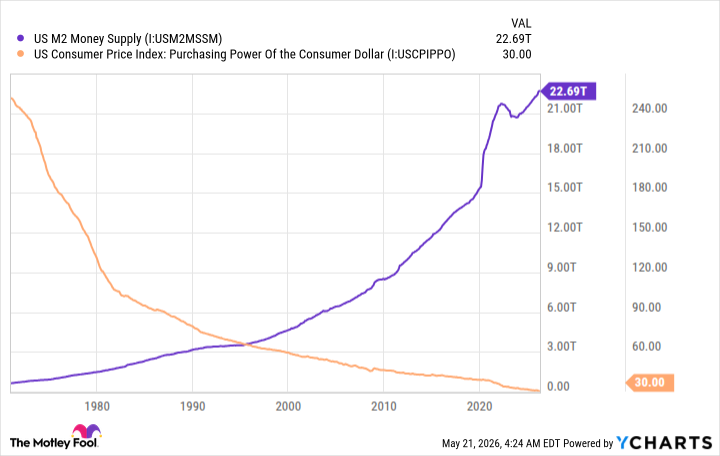
US M2 Money Supply data by YCharts
Therefore, any asset priced in U.S. dollars — like gold and silver — has steadily increased in value in dollar terms.
The U.S. government ran a budget deficit of $1.8 trillion in fiscal 2025 (ended Sept. 30), which sent the national debt barreling toward a record high of $40 trillion. Investors fear this could lead to a sharp increase in money supply in the future, as policymakers try to devalue the dollar to inflate away the debt. That is a big reason why investors piled into precious metals last year.
History points to muted returns from here
The U.S. government is on track for another trillion-dollar budget deficit in fiscal 2026, and with no immediate end to China’s export restrictions in sight, conditions seem perfect for more upside in silver. Why, then, is the iShares Silver ETF currently down so sharply from its peak? Simply put, silver’s gain of 144% in 2025 was so far above its historical annual average that a period of consolidation was inevitable.
Over the last 50 years, silver has climbed at a far more modest compound annual rate of just 5.7%, which is a more realistic target for investors going forward. Plus, there might actually be a fly in the ointment for the bullish case — at least in the near term.
The Consumer Price Index (CPI) measure of inflation came in at an annualized rate of 3.8% in April, which was the highest level in three years. Therefore, after six interest rate cuts from the Federal Reserve since September 2024, Wall Street is now pricing in a potential interest rate hike before the end of this year.
Tighter monetary conditions will typically slow the increase in money supply. In fact, when the Fed embarked on its last campaign to raise interest rates in 2022 and 2023, its balance sheet actually shrank by around $2.4 trillion. Moreover, higher rates could force the U.S. government to slash spending, as interest costs on the enormous national debt threaten to blow out the budget.
Therefore, if inflation continues trending higher, precious metals like silver could actually deliver below-average returns for the next year at least.